
Monday, April 25, 2011

Poisoning the Wells Fracking the Wind River Country

How a Small Wyoming Town Might Be the First to Prove its Water Damaged by Natural Gas Production
Despite the testimonies of the people living by gas drilling, the companies have yet to be held accountable for damages. That might change.

ANDREA PEACOCK
March 25th 2011
Pavillion, Wyoming.

Jeff and Rhonda Locker’s water changed abruptly one day in the mid-1990s while Rhonda was doing the laundry. A Denver-based gas company was working over an old well in back of their house, when the wash water turned black. “It happened just like that,” Jeff Locker says. “I stopped him and asked him what he did to our water, and of course he didn’t do anything to our water… It’s been bad ever since.”

Donna Meeks’ well water was so good, she used to haul it to town for the school office coffee pot. Neither she nor her husband Louis noticed anything wrong until her co-workers stopped drinking the coffee; it was 2004, and a Canadian company, EnCana, had just drilled a new well about 500 feet from the Meeks home. Some visiting friends later said they noticed the water tasted and smelled like gas, but didn’t want to be rude by saying anything about it.

John and Cathy Fenton had no reason to suspect there was anything wrong with their water—it tasted fine. But just to be neighborly, they went along with the Lockers, the Meeks, and other Pavillion-area residents when the Environmental Protection Agency came in 2009 for an initial round of testing. That’s when they found out that their family had been drinking water laced with methane. Follow-up tests a year later found a whole soup’s worth of semi-volatile organic compounds in the family’s stock well....continued....

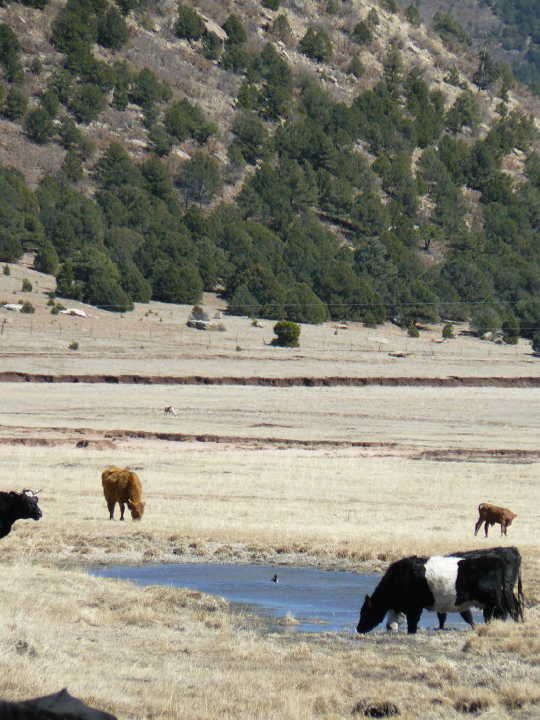
Cattle vs. Conoco: How Gas Fields are Crowding out New Mexico Ranchers

By ANDREA PEACOCK
March 24th, 2011
Blanco, New Mexico.

Chris Velasquez sees the impacts of gas development in the San Juan Basin of northern New Mexico through the eyes of a rancher, and those of a man whose roots in this country pre-date both the gas rigs and the arrival of Anglos.

He and his dad ran cattle, until recently, on a grazing allotment called the Rosa, rolling high desert lands punctuated by bluffs and arroyos, ringed by mesas, adjacent to the Carson National Forest on the east, the Southern Ute reservation to the north, and bordered on the west by Navajo Lake. In a way, it’s what’s left of Velasquez’ ancestral homeland. “We used to live where the Pine River and the San Juan meet up here, then when they built the lake, it either was drown or move,” he says. In 1962, the Bureau of Reclamation completed a dam stretching three-quarters of a mile across the San Juan River. The idea was to control flooding and provide irrigation water for the Navajo tribe. It also displaced Velasquez’ community. “All my ancestor’s on my mom’s side, well on my dad’s side too, came from right up here,” he says. “My grandpa and my grandma on my mom’s side, they were the second farm below the dam. They got chased out too. From right here on, all the people who lived here—they were all Spanish people—relocated. Threw them to the four winds. Scattered them all over the place.”

The Velasquez family wasn’t blown far: his dad bought a place near Blanco, New Mexico, the nearest town with a name, a short drive west and south of their former home.  The entire clan now lives and ranches on about 320 acres they share with 17 gas wells. “My dad’s the one that started the ranch, but we’ve always had animals,” he says. It was the former owners who sold the mineral rights back in the 1930s or 40s. “So they’ve been after this area for a long time,” he says. “They’ve been hammering it, it didn’t happen overnight. They had a vision for it.”.....continued..

Drafting Nature's Constitution: Simply regulating pollution will never really stop it--Yes! Magazine

Mari Margil
March 2nd 2011

The environmental movement, with its army of professional advocates, lawyers, grassroots campaigners, and dedicated funders, has been around for decades. Yet nearly every biological indicator shows a planet in crisis—and poised to unravel faster as climate change disrupts already-shaky ecosystem functions.

Mari Margil, associate director of the Community Environmental Legal Defense Fund (CELDF) believes it's time for different tactics. The nonprofit agency used to work within the body of existing environmental law—helping impacted residents file lawsuits or appeal corporate permits—to protect communities from environmental damage. But a series of blocked efforts, often made worse by the very agencies meant to protect the environment, convinced the group that more fundamental changes were necessary.

"Our system of environmental laws and regulations don't actually protect the environment," says CLEDF's Mari Margil. "At best, they merely slow the rate of its destruction ... We weren't helping anyone protect anything."

The organization has since changed its goals, working with citizens from all over North and South America to literally rewrite local laws in ways that allow people to speak up for their communities, watersheds, forests, and air.
....continued......

Megaloads, water company: Ordinances help local communities fend off corporations

KEILA SZPALLER
 March 20, 2011

Last year, ExxonMobil publicly reared its head in Montana with a plan to shoehorn 200 megaloads onto U.S. Highway 12. Since then, the Carlyle Group announced the pending purchase of the California company that owns Mountain Water in Missoula.

Activism is alive and well here, and Missoulians are writing letters, signing petitions and marching in the streets. In City Hall, Mayor John Engen is getting emails calling for the city of Missoula to buy Mountain Water.

On the other end of town, in the wee hours of March 10, hundreds of activists temporarily plugged Reserve Street when the first megaloads rolled through Missoula - these big rigs belonging to ConocoPhillips. But the giant trucks passed anyway, just as they had inched along the federally protected highway along the Lochsa River.

When it comes to the will of the people and corporate autonomy, the deck is stacked in favor of corporations, said Zack Porter, a spokesman for All Against the Haul. It is just one group that formed to fight Big Oil from building a permanent corridor through Oregon, Washington, Idaho and Montana for these loads, which can weigh as much as 700,000 pounds.

"Right now, the burden of proof is on us to demonstrate these projects are unsuitable. The burden of proof should be on the corporations," Porter said.......continued........

Tackling Corporate Power, One Town at a Time: What’s a town to do when state regulatory agencies don’t keep corporate drilling out?--Yes Magazine

by Mari Margil
March 17th 2011

As more information about the dangers of hydraulic fracturing, or "fracking," (a technique used during natural gas drilling) emerges, more and more cities and municipalities are organizing to keep drilling and fracking out of their own communities, but are surprised to find that they do not have the legal authority to say “no” to these corporate activities.

Last week, Mountain Lake Park, Maryland, with fewer than 2,500 residents, became the latest community to do something about this, adopting the state’s first ordinance banning corporations from natural gas drilling.

Drafted with the help of the Community Environmental Legal Defense Fund, the ordinance comes on the heels of the City of Pittsburgh’s ordinance banning drilling by corporations, adopted in November. Both ordinances also eliminate the authority of corporations to wield their constitutional rights to override the municipality's wishes. Such constitutional rights and powers are often used by corporations to overturn local and state laws adopted to protect the environment and public health.
 
More and more communities are organizing to fight drilling and fracking, but are surprised to find that they do not have the legal authority to say “no” to these corporate activities.

A similar ordinance was recently introduced in Wales, New York; it comes up for a vote in April. If adopted, it would make Wales the first community in New York to restrict corporate rights and ban corporations from drilling.
....continued.....

Fracking Will Cause 'Irreversible Harm': Shale-Gas Extraction After-Affects Will Threaten Drinking Water, Could Jeopardize Agriculture, Expert Says--Montreal Gazette

 Kevin Dougherty
March 4, 2011
 
QUEBEC - A geological engineering professor whose specialty is rock mechanics and hydrogeology says hydraulic fracturing to free natural gas from shale rock formations will cause "irreversible harm" lasting thousands of years.

And the gas companies will be long gone, leaving behind costly remediation, Marc Durand said in an interview, suggesting the gas producers should be forced to establish a reserve fund.

"The billions required would be much more than all the profits beckoning now," said the retired Université du Québec à Montréal professor.

The circulating gas left behind will threaten the water Quebecers drink and could jeopardize agriculture, he said. The Utica shale field gas deposits between Montreal and Quebec City lie under some of the best farmland in the province.

"Fracking" is the technique of pumping a mixture of water, sand and a cocktail of toxic chemicals under pressure into wells drilled horizontally to liberate the gas from the shale.....continued.....

The Privatization of Municipal and County Governments

 In the March 9th Amy Goodman/"Democracy Now!" report, March 9th, 2011, Naomi Klein was interviewed.  Listen to what she has to say about the current bill introduced into the Michigan legislature and to her interview with Naomi Klein:  click on heading.....to listen to youtube of Democracy Now!
This is a summary of part of it "Democracy Now!" 3/9/2011:

 A bill in the Michigan state legislature would in the case of an emergency, give an appointed person or a firm (corporation) the authority to  dissolve the municipal/county government and run it.  This law being passed in Michigan now could happen anywhere, according to Naomi Klein, where a corporation would "become" the government of that municipality or county.

 This has happened in Sandy Springs, Georgia.

Currently we are seeing this occurring in the privatization of our school systems.  When Katrina occurred, the public school system was dismantled in New Orleans and replaced with privatized publicly funded charter schools. I heard on Democracy Now last week that this same dismantling is
Rhode Island where minority children will have no opportunity to attend a publicly funded school system.


COMMENT:
The efforts we put in place on the local county and municipality levels to exercise our rights to "local self governance" are critical at this point in history. Never before have we seen such actions coming forth in this country.  Germany under Hitler, yes, but not in the United States of America until now.

 New Mexico State Constitution:
"Right of self-government. “The people of the state have the sole and exclusive right to govern themselves as a free, sovereign and
independent state. ” N.M. CONST., Art. II, § 3."

The Community Environmental Legal Defense Fund (celdf.org) has written over 125 community rights ordinances expressively exercising the right of "local self governance" for communities across the United States and abroad to protect human rights and nature's rights---clean air, water, land, ecosystems.

Drilling Mora County


Saturday, April 23, 2011

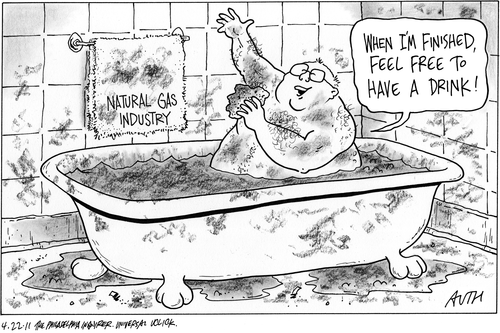
Colorado Number Two in Carcinogen-Laced "Fracking" Fluids--Denver Post

Allison Sherry
 04/22/2011

WASHINGTON — Colorado ranked second only to Texas in terms of the number of gallons of carcinogen-laced "fracking" fluids used in oil and gas extraction between 2005 and 2009, according to congressional Democrats.

A 30-page House Energy and Commerce report — the second release in an investigation into hydraulic fracturing — shows that 1.5 million gallons of fracking fluids containing a carcinogen were used in Colorado in that time, compared with 3.8 million gallons in Texas and 1 million in Oklahoma. The report does not show the concentrations of those chemicals or that the carcinogens, including naphthalene and benzene, have endangered drinking water near the drilling sites in Colorado.

State leaders charged with regulating Colorado's energy industry say the report's findings are not a surprise.

"Generally, we know what kinds of chemicals are in frack fluids," said Dave Neslin, director of the Colorado Oil and Gas Conservation Commission. "We're still looking at it (the report). But from a high level, we know what they are and how they're used and how they're used in other parts of our lives.".....continued.....

Tuesday, March 29, 2011

Germany’s solar panels produce more power than Japan’s entire Fukushima complex

 
Germany is the world leader in installed solar photovoltaic panels -- and they also just shut down seven of their oldest nuclear reactors. Coincidence? Maaaaybe... Anyway, it's worth noting that just today, total power output of Germany's installed solar PV panels hit 12.1 GW -- greater than the total power output (10 GW) of Japan's entire 6-reactor nuclear power plant.

Now before the trolls come out, let me just note that 12.1 GW is max power (the output whose name you'd love to touch). The panels generated that much at one instant in time -- when the sun was at its apex -- but of course solar power production varies with the weather and the time of day. To find out how much energy those panels generated today in total, you'd have to calculate the area under that curve in the lower right hand corner. (Which, come to think of it, we should probably use as the CAPTCHA on the comment field on this post.) ....continued.....

Gilbert Armenta's Story of Oil and Gas in San Juan County, NM--Part IV

PART IV

And then it goes on to say, "Give us this day our daily bread." It is not saying "Give us 10,000 oil and gas wells." Or what is it saying? I get it. We are asking to be fed what we need every day what we need until the day we die.

I was born in 1946.  When I was three months old my mom and dad did a new oil and gas lease for 5 more years. Well, what do you know? They drilled a gas well. Now this oil and gas lease lives on forever. When they drilled the first well, it caught on fire and they had a mess all over the farm trying to put it out. You might ask, "Did they pay for the damage they did?"  You bet they did. A total of $200 'take it or leave it.'

When mom and dad agreed to the lease they were told that all the gas would be gone in 10 years. Well, many 10 years have past and now we have over 12 wells and counting--on just 160 acres. Each well takes over five acres to drill. So, as you see, the oil and gas companies have taken all, most all, of my farm.

Now, to drill a gas or oil well will do them no good. They need to sell their product. That means pipe lines--miles and miles of them.

Yes, on the farm you cannot build or work the land without asking the oil and gas company, first. This is by law, and yes, the gas companies went to the goverment and passed this laws for them.

Next: What happend after the first gas well was drilled in 1950?

 Gilbert

Saturday, March 19, 2011

Gilbert Armenta's Story of Oil and Gas in San Juan County, NM--Part III

Part 3

Our father who art in heaven halo be your name thy kingdom come thy will be done on earth as it in heaven. How many oil and gas wells do you think there are up in heaven? Well here in the San Juan Basin we have about 50,000 or more so it must be a mess up there you think? About 1920 there was a great drought here in the San Juan Basin and there was no crops to sell and the livestock were poor. And then came the great depression of the 1920's and 30,s the land taxes and debts could not be met and those that could not pay lost their lands. Most of those that lost their lands were Spanish.

The white man that had money got the land by paying the taxes that were not paid. That was done because the white man ran the government here and knew what lands were up for sale for lack of none payment of taxes. From the 1920,s to the 1950,s the oil men would come and get a 5 year lease but would not drill on the land they sometimes would pay about $25 for a 5 year lease. Well for not drilling $25 was OK and everyone got used to the little money they were getting. Well what do you think happen next? 


It was not good next.       Gilbert  March 14, 2011


Gilbert Armenta's Story of Oil and Gas in San Juan County, NM--Part II

 Part II:

Oil and Gas what is it? It is dead matter. When God created the heavens and the earth he said it is good and he made man and gave man dominion over all living things.

Well as you see oil and gas is dead and as man we are not to use it. In 1900 or about oil was located in the San Juan Basin down hole about 80 feet. In 1920 Gas was found about 600 feet down. As I said before in 1598 the Spanish came as farmers and herders and for over 250 years that is what they did. They also did a little mineing for gold and sliver with slave labor (native people) but for the most part it was farming and raising livestock. In the 250 years that spain ruled we became a mix blooded people. We had no interest in oil and gas. In 1846 the United States went to war with Mexico a poor country and we were defeated and we lost are lands. That is when the white man came in and started to rape the people and the land. 


The white man are very greedy living in harmony is not there way take take take is. In 1860 a great war was going on here that is when my people came hear to the San Juan Basin to make a new life they came with there livestock and to farm. It was good land and soon they were doing very well. The hispanos controled 86% of the land they were very well off. 

Next:  how we lost our lands and our way of life to oil and gas.     Gilbert Armenta   February 9th 2011


Gilbert Armenta's Story of Oil and Gas, San Juan County, NM-- Part 1

Part 1--Writing at the request of Ian Perrin, South Africa, a citizen group resisting Royal Dutch Shell's natural gas exploration of the Karoo  (www.fractual.co.za):
 
Ian if you know the history of the new world it started in 1492 and hear in 1598 that is when my story begins. The Spanish government settled hear then. No females came at this time so as you can see we (I) am of Spanish and Native American Blood. For 200 years plus we were part of the Spanish rule. Now Spain received this new World from God as the King of Spain said at that time. Now if you were a Vescino (subject) you could ask the Crown for a Grant (land) and many Grants were given to the her subjects. Many races were sent here by Spain (Spanish Blacks Jews etcs.) The times were hard here. 


When Spain settled here large herds of horses, sheep,goats, cattel, also pigs,ect, came with them and also all kind of plants and trees. next Mexico (1821) my Great Grandfather was born in 1817 four years before Mexico independence from Spain. My great grandfather Jose Armenta came to the San Juan Basin in 1867 his wife died and he bought my great grandmother ( custom of that time) she was Native American. My grand father Romaldo Armenta was born in 1896 USA (united states to over in 1848) and he and my grand mother (also a Native American) had my father in 1916 (new mexico USA became a state in 1912) I was born in 1946. 

Next I will tell you about the start of oil and gas.                Gilbert Armenta , January 22, 2011

Friday, March 11, 2011

Fracking Will Cause 'Irreversible Harm': Shale-Gas Extraction After-Affects Will Threaten Drinking Water, Could Jeopardize Agriculture, Expert Says--Montreal Gazette

By Kevin Dougherty
March 4, 2011

QUEBEC - A geological engineering professor whose specialty is rock mechanics and hydrogeology says hydraulic fracturing to free natural gas from shale rock formations will cause "irreversible harm" lasting thousands of years.

And the gas companies will be long gone, leaving behind costly remediation, Marc Durand said in an interview, suggesting the gas producers should be forced to establish a reserve fund.

"The billions required would be much more than all the profits beckoning now," said the retired Université du Québec à Montréal professor.

The circulating gas left behind will threaten the water Quebecers drink and could jeopardize agriculture, he said. The Utica shale field gas deposits between Montreal and Quebec City lie under some of the best farmland in the province.

"Fracking" is the technique of pumping a mixture of water, sand and a cocktail of toxic chemicals under pressure into wells drilled horizontally to liberate the gas from the shale.

But Durand noted that fracking gets out only 20 per cent of the gas, a figure confirmed by Canada's National Energy Board.

After maybe eight years of production, the gas companies will seal - and forget - the wells, Durand said.

The rock formations shattered by fracking will be "thousands of times more permeable," allowing the remaining 80 per cent of shale gas and underground water, 10 times more salty than sea water, to continue circulating, bubbling to the surface through the disused gas wells.

Over time, methane could leak into the groundwater and gas leaks could gush, uncontrolled, into the air...continued....

Thursday, March 10, 2011

Leaked EPA Documents Expose Decades-Old Effort to Hide Dangers of Natural Gas Extraction

Efforts by lawmakers and regulators to force the federal government to better police the natural gas drilling process known as hydraulic fracturing, or "fracking," have been thwarted for the past 25 years, according to an exposé in the New York Times. Studies by scientists at the U.S. Environmental Protection Agency on fracking have been repeatedly narrowed in scope by superiors, and important findings have been removed under pressure from the industry. The news comes as the EPA is conducting a broad study of the risks of natural gas drilling with preliminary results scheduled to be delivered next year. Joining us is Walter Hang, president of Toxics Targeting, a firm that tracks environmental spills and releases across the country, based in Ithaca, New York, where fracking is currently taking place....click on title to watch full interview from Democracy Now!

Shell takes gung-ho stance on Karoo fracking outrage--The Daily Marverick

EXCERPT:
"We expected Shell to take on a patronisingly bullish tone on the issue of fracking, and they did not disappoint."

By SIPHO HLONGWANE
March 10 2011

Royal Dutch Shell, a global corporation the size of a small nation, is facing a growing outcry against its plans to conduct hydraulic fracturing in the Karoo. Still, it took on a  “frack now, deal with any fallout as it happens” stance at a press conference on Thursday. And although compensation promises were made, it is nothing you can take to the bank.
Royal Dutch Shell went to some effort to make the process of hydraulic fracturing seem rather harmless
to a roomful of journalists, with a friendly PowerPoint presentation, full of bullet points and video that explained the process. The process of fracking has received an avalanche of bad press in the US, leading to precautionary banning in some states, and now Shell wants to take the controversial process of mining unconventional gas to the Karoo.

Bonang Mohale, chairman of Shell Oil Product Africa, and Graham Tiley, general manager of New Venture Executions at Shell are hosting press conferences in Cape Town, Port Elizabeth and Johannesburg in an effort to allay fears about the process....continued.....

Wyoming Air Pollution Worse Than Los Angeles Due To Gas Drilling--Huffington Post


Wyoming Air Pollution Worse Than Los Angeles Due To Gas Drilling
By MEAD GRUVER 
03/ 8/11

CHEYENNE, Wyo. -- Wyoming, famous for its crisp mountain air and breathtaking, far-as-the-eye-can-see vistas, is looking a lot like smoggy Los Angeles these days because of a boom in natural gas drilling.

Folks who live near the gas fields in the western part of this outdoorsy state are complaining of watery eyes, shortness of breath and bloody noses because of ozone levels that have exceeded what people in L.A. and other major cities wheeze through on their worst pollution days.

"It is scary to me personally. I never would have guessed in a million years you would have that kind of danger here," Debbee Miller, a manager at a Pinedale snowmobile dealership, said Monday.

In many ways, it's a haze of prosperity: Gas drilling is going strong again, and as a result, so is the Cowboy State's economy. Wyoming enjoys one of the nation's lowest unemployment rates, 6.4 percent. And while many other states are running up monumental deficits, lawmakers are projecting a budget surplus of more than $1 billion over the coming year in this state of a half-million people....continued.....