Sunday, October 4, 2009

Another Letter to the Santa Fe Opera Director, Charles MacKay


Dear Mr. MacKay,
As a resident of Mora County and a long time student of opera, I write to you to protest your ill-considered action in signing contracts with a group of oil companies. I am afraid that you have, very early in your tenure as director, precipitated the largest crisis in the history of the Santa Fe Opera. I urge you to reconsider your decision
and to withdraw from the contracts. It would have been prudent if you had made your negotiations public before you signed. Instead you have alienated friends of the opera and involved our opera company in what may be a long legal battle with those who wish to protect the state of New Mexico and two of its unspoiled counties from wanton destruction. The last thing you should want to be is Nemico della patria (Andrea Chenier III; try Merrill or Zancanaro) either of these should give you the meditative climate for you to rethink what you have done.

Sincerely,
Ted Riccardi
Golandrinas, New Mexico

"Residents Not Told About Land Deal -Sound of Silence"-Albuquerque Jounral North

Opinion Editorial Albuquerque Journal North October 4th 2009

Residents Not Told About Land Deal: Sound of Silence

By Kathleen Dudley

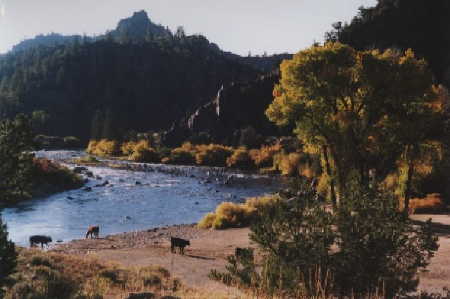
It's the wind in the cottonwood trees and the stillness at dawn and dusk, crowing roosters and lazy, dusty, meandering lanes in Mora County that draws one's breath into oneself and makes this land palpably breathtaking. The sharp, crisp, autumn air, and the sweet, pure water of the high mountain region assuage our souls and spirits and give meaning to life. Nature does that to those who stand in her presence and honor her gifts — all 1,244,160 acres.

This is about to change, or so we are told by Shell LTD, who stated in July 2009 that they will begin development within a year. However, the silence around the impending oil and gas explosion in Mora County remains otherwise shrouded in secrecy with the exceptional absence of a public process. No survey, no meetings to inquire what the citizens want for their county, just the stillness "idyllic Mora County" presents to those who revel in its beauty.

The commission is not talking, the planning and zoning committee is not talking, the county land use administrator is not talking. The only person who would talk is no longer county manager — our 11th county manager in 10 years!

At the time Tecton and KHL Inc. began their departure from Santa Fe County in 2007-2008, Knute Lee arrived here in Ocate, sponsoring a barbecue to announce that wealth was about to arrive to the fifth-poorest county in New Mexico. Mineral leases were their game and extraction was their goal. And only those whom they contacted would know what was about to happen in this county. continued........

Saturday, October 3, 2009

Santa Fe Opera, Vandegrifts and Dr. Alexander lease their mineral rights in San Miguel and Mora County

And who owns the surface property? This is being determined by Drilling Mora County. The first area mapped shows the 36,000 acres of land in San Miguel and Mora Counties of which 26,747 acres of mineral rights have been leased by the four parties to J Bar Cane. One of those parties, Santa Fe Opera director, Charles MacKay, states that it is his fiduciary responsibility to lease the mineral rights for the financial support of the opera. However, the opera's guidelines for gifts is more delineated than that. See www.drillingsantafe.blogspot.com for the full scoop. MacKay's actions were obviously efficient and precise, yet irresponsible to the landowners and neighbours in the counties where oil and gas development is being opposed.

The lease MacKay signed gives drilling companies the legal right to build worker housing, run roads
and lay pipes anywhere across the surface owner's land they choose (even if it might be the alfalfa field), and extract their water along with setting up gas wells and running compressors 24/7 at their discretion. In fact, if the water wells run dry or contaminated, all in a days work. This "highway robbery" is done with only the Surface Owners Protection Act for the land owner--which essentially gives them no rights what-so-ever. There is no law even enforcing the mineral owner to notify the surface owner that the leases are being considered for sale or are sold.

The map above shows four rough groupings of squares, each one apparently representing one of the four lessors of mineral leases. Each small square within these areas represents a square mile or 640 acres. The 26, 747 acres lie some where inside these squares which make up the 36,000 acres of land.

The four parties who leased mineral rights are
1. Dr. Marcia Alexander
2. Lyn M Vandegrift and Byron and Margaret Vandegrift
3. Joan Mary Vandegrift
4. Charles MacKay, Santa Fe Opera

Physical mapping of these properties shows approximately 7,000-8,000 acres in the Mora Land Grant, Mora County, with the balance in San Miguel County, including the San Miguel Land Grant. The 26,747 acres cross Interstate 1-25 in two places.


Thursday, October 1, 2009

Drilling Mora County Media Chair writes to the Santa Fe Opera Director, Charles MacKay

Mr. MacKay,
I am a resident of Mora County concerned about the proposed oil and gas drilling here. I was appalled to learn that you had leased more than 26,000 acres worth of mineral rights in Mora and San Miguel Counties. I find it reprehensible that an organization dedicated to the arts would sign away mineral leases in counties that are resisting unregulated oil
and gas development.

You have cited financial need as your reasoning for signing this lease. I expect however, that you will find your attendance numbers dropping due to the moral discrepancies you have displayed by leasing the minerals of this land on which you do not live. I am deeply saddened that, while my tax dollars have been given to your organization, you would rather assist in destroying the water, health, and environment of myself and fellow county citizens than find another way to fund your programs. While you have mentioned your “history of environmental commitment” your words resound with hypocrisy.

If the Santa Fe Opera was genuinely committed to preservation of the environment, this lease would have never been signed. I find this leasing of mineral rights in our underprivileged county to be against everything I previously believed the arts stood for. Much art is inspired by nature. I doubt many artists find gas wells and the toxic cesspools that accompany them to be very conducive to their expression of art.

It is my hope that, as a respected organization in good standing with the residents of New Mexico, you will reassess the way you make decisions and develop some concern for the way these decisions impact surrounding communities.

Respectfully,
Aravis Kurtiz
Media chair, Drilling Mora County
>

Letter to the Santa Fe Opera Director, Charles MacKay


Dear Mr. MacKay,

I was truly shocked to learn that you have sold the gas and oil exploration rights to land co-owned by the Santa Fe Opera in San Miguel County.

You have justified the move by citing an obligation to continue programs for young opera apprentices. But you are robbing Peter to pay Paul. How can you protect one group of young people while jeopardizing the health and well being of other young people, the ones who live in Mora and San Miguel counties? That is hypocrisy indeed.

If the Santa Fe Opera needs money so badly, why did you not first put out a fund drive and appeal to all of your supporters?

If, after considering all options, you felt compelled to lease the rights, why did you not insist on stringent environmental safeguards?

It is pointless to speculate whether you would have sold the right to drill right underneath and around the Santa Fe Opera to these ruthless companies, because wiser, more principled heads than yours have prevailed in Santa Fe County, making it illegal. So you exploited a poorer, less educated county, instead. Your action speaks volumes about the elitist attitudes some people ascribe to urban cultural institutions. Let a county where the folks are poorer and less
educated take the pollution, the ugliness, the terrible health hazards leading to untimely deaths and disease. Let us take the money.

I hope you realize that you made a terrible mistake. I urge you to say so publicly; to apologize to all those you have offended and all those you will be wounding in the future with your actions; and to see what you can do to make amends. My husband and I love the opera, but no longer the Santa Fe Opera. I am sure there are many like us.

Sincerely,

Ellen Coon
Golondrinas, New Mexico

Considering the Proposed Amendments to the Sites SW revision of the Mora County CLUP by Shell Corp

by Don Shaw, Drilling Mora County

Take each amendment Shell makes to Sites SW proposed CLUP and list them in order in a left hand column. Then in the right hand column make an interpretive note of the recommended amendment in terms of what liabilities it relieves Shell of if they pursued O&G development in Mora County.

You will find the sum of these suggested amendments frames a working profile for Shell of no liability, no responsibility to stated CLUP goals, no county Ordinance regarding performance and no limits or liability from working extraction in the County.

The only recognized restrictions or controls are the State and Federal laws already on the books and none of which protect the Counties CLUP stated goals regarding the land, air, water or infrastructure nor in any way its citizens.

To agree to these changes verges on a criminal act especially considering the Mora CLUP was written with stated goals to specifically protect the County and its Citizens.

Wednesday, September 30, 2009

"Traitorous Libretto"--Santa Fe Reporter


By: Zane Fischer 09/30/2009

Think you own your property? Think again. The tricky “split estate” law has been screwing New Mexico and the rest of the West since its inception. The purchase of land that includes water and mineral rights is rare indeed in these parts—usually those rights have been sold off long before the present-day owners bought their so-called property.

Most people don’t realize they only own the surface of their land; what lurks beneath is the property of others to do with as they please.

A split estate is the legal—oh how should we put it?—or bullshit term for delineating land divided between a surface estate and a mineral estate. And, yeah, that’s most land in New Mexico.

The kicker? Mineral estates generally take legal precedence over surface estates. In other words, let’s say you own a couple of acres: You worked your ass off to buy the plot and, luckily, you’re still able to work your ass off to keep up with the mortgage. It’s a bitch, but at least you’re building equity and you know the ground you sleep on is home to you and yours, and no one can take that away from you as long as you hold up your end of the bargain.

Unless, of course, the owner of the mineral rights decides to roll up and start extracting helium or coal-bed methane or any number of other bits of nasty, polluting, water-table-depleting sorts of stuff in the ground that might be traded for cold, hard cash. The actual ground can’t be taken from you, but the earth below can be pillaged, and the equipment required for the rape can be erected outside your front door.

To put a finer point on this, take the case of the Santa Fe Opera (as first reported Sept. 24 by SFR on SFReeper.com, with several updates since).

In a 2002 gift from the Shellaberger estate, the opera and the College of Santa Fe were given joint ownership of a share in mineral rights to more than 26,000 acres in Mora and San Miguel counties.

In 2009, the opera (acting with the urging of CSF) agreed—along with three other owners—to lease those rights out for oil and gas exploration. None of the parties—including the opera and CSF—own the land or the water rights, but they control the mineral estate, which impacts both the quality of any profits generated from the land and the ground water. In return for leasing their share, the opera and CSF are set to receive a modest fraction of profits from extracted treasures. Hey, fair play, the opera is a struggling nonprofit and its mission is opera, not the environment.

That’s the line that SFO General Director Charles MacKay took in a Friday, Sept. 25 statement to the press. MacKay claimed that leasing out the mineral rights was the only way to honor the bequest it had received and to ensure the opera meets its significant fiduciary responsibilities (to learn more about what MacKay has to say on this issue here. The college, as we know, continued to grasp at every monetary straw it could find, until its purchase by the City of Santa Fe was completed earlier in September.

However, CSF maintained ownerhip of the mineral rights in the deal. It remains unclear what the soon to be defunct entity will do with those rights.

As anti-drilling activists in Mora County point out, it’s unlikely the opera or CSF would have had the hubris to do a similar deal in Santa Fe County—it would be too obviously politically incorrect—but both were apparently happy to cut a deal in a place perceived as somewhere else. Never mind that the college was quietly scheming to profit even as it vied to be taken over by San Miguel County-based Highlands University in a deal killed by the New Mexico Legislature.

As much as we routinely suspect our corporate citizens of generally illicit behavior, we have a tendency to assume that our nonprofit corporations will uphold a higher standard in their business dealings. Frequently, that happens to be true. But this situation has demonstrated, once again, that even adored, creative, cultural and educational producers can be guilty of putting greed before citizenship.

The issue is less the money that may or may not be made, but the failure to understand the potential impact of the actions. The extraction of coal-bed methane, for example, can damage a water table to the extent that it takes 10,000 years to recover. That’s an instant sea change in culture, livelihood, food production, wealth and future for thousands and thousands of people. It may not happen this year or 10 years from now, but the opera and CSF knowingly mortgaged the futures of Mora and San Miguel counties’ landowners for little more than a gamble. And the college did so from its deathbed, knowing that the deal would neither save nor sink it.

Sounds like a juicy libretto, right?


Saturday, September 26, 2009

Opera: Finances Led to Drilling--Albuquerque Journal North

by Polly Summar
staff reporter

front page September 26th 2009

The Santa Fe Opera's general director says financial obligations led the opera to lease mineral rights it owns on land north of Las Vegas, N.M., for oil and gas drilling.
Opera general director Charles MacKay signed a lease between the opera and J Bar Cane, Inc., in April, giving the company permission to drill on more than 26,000 acres in Mora and San Miguel counties. It was filed in Mora County last month.
"We had no recourse other than to sell or lease these rights in order to maximize their benefit to the Opera and to meet the organization's fiduciary obligations," MacKay said in a statement issued Friday.
MacKay said the opera received a bequest from a long-time donor in December 2002 that included a share in the mineral rights for the land. "We do not own the property itself, just a portion of the mineral rights," MacKay said in the statement.
John M. Richardson, who owns J Bar Cane, a petroleum land management firm based in Stanley, said Friday his company assembles drilling prospects for other companies. "We bought those leases for a client," said Richardson, adding that he can't reveal the client's name.
"As far as I know, they (the client) don't have any plans to do anything soon or we would have been involved to lay the groundwork for drilling locations," Richardson said.
Drilling plans in Santa Fe, Rio Arriba and Mora counties have provoked intense opposition in recent years over environmental concerns. The news that the opera had leased rights for drilling — first posted on the Internet on Thursday by the anti-drilling groups Drilling Santa Fe and Drilling Mora County — provoked quick reaction.
Johnny Micou with Drilling Santa Fe said Friday he'd received dozens of e-mails from people who are "appalled."
"Here we were with this huge public outcry (against drilling in the Galisteo Basin south of Santa Fe over the past two years) and then the Santa Fe Opera turns around and goes to a poor county and leases nearly 27,000 acres for mineral exploration and development," Micou said.
Micou said many who've e-mailed Drilling Santa Fe and who support or attend the opera "are saying they're going to boycott the opera."
He said there were no clauses in the lease agreement signed between the opera and J Bar Cane providing any environmental protections or restrictions on drilling methods.
Kathleen Dudley with Drilling Mora County, asked: "Why would an arts company, a revered company, knowingly sign leases that would degrade an agricultural county?"
Dudley said if MacKay had agreed to similar terms in Santa Fe County, "he would have been tarred and feathered."
A Texas company recently abandoned plans to drill south of Santa Fe amid a prolonged public outcry and a revised county ordinance that reiterated tough restrictions on where drilling can take place.
'Environmental commitment'
MacKay said in his statement that the opera "has a long tradition of environmental commitment," citing its $750,000 investment in a wastewater treatment plant that it operates jointly with Santa Fe County. The opera also has adopted "a wide-ranging program to re-use or recycle materials, including scenery and costumes, to the highest extent possible," the statement said.
MacKay said the donor of the mineral rights stipulated that the bequest be used to support the opera's apprentice programs. "The Opera strives to operate in a fiscally responsible manner, in keeping with its legal mandates as a not-for-profit organization, and to honor the wishes of its donors," MacKay said. As a result, he said, the Opera had to sell or lease the mineral rights.
Richardson said the land is located north of Las Vegas, N.M. Dudley said it's between N.M. 518 at Sapello and Interstate 25 at Watrous, in the vicinity of the communities of Los Alamos and Emplazado and Lake Isabelle, on the San Miguel and Mora County line. Dudley said there are four owners of the property.
The lease signed by MacKay says the opera is lessor for about 27,000 acres in San Miguel and Mora counties, although his statement released Friday says the donation to the opera was for mineral rights in Mora County. His statement didn't address the question of other owners raised by Dudley.

Charles MacKay, director, Santa Fe Opera, signs mineral leases in Mora County

email: Charles MacKay, director, Santa Fe Opera-----director@santafeopera.org

Email to Charles MacKay:
As a musician, fine artist, and co-chair of Drilling Mora County, concerned citizen group, I was surprised to read Santa Fe Opera/Charles MacKay's name on the list of recorded leases when I checked at the Mora County clerk's office two weeks ago.

My own inspiration for my art comes from Nature. And I have seen that to be true of most artistic endeavours throughout history. To read the name of the Santa Fe Opera amongst those who took money in lieu of valuing the impact of their actions on their neighbours tells me that money is more important than what feeds the soul of the Santa Fe Opera's director. How can this leadership inspire such artistic endeavours?

We all have been impacted by the economic downturn, but those who sell out the "others" in order to succeed in this lifetime must not understand that someone will be harmed in this action. I can only hope that Mr. MacKay can rectify his actions and find another solution to funding the arts. When we destroy our inspiration, we destroy our souls in the process as well.

Kathleen Dudley
co-chair, Drilling Mora County

Thursday, September 24, 2009

Santa Fe Opera Signs Oil/Gas Lease in Mora/San Miguel Counties

Santa Fe Opera Company, general director, Charles MacKay, signed an oil and gas lease April 20th with J Bar Cane, landman ( managed by John Michael Richardson), of Stanley, New Mexico. The 26,746 acre parcel is co-owned by four parties, of which Santa Fe Opera Company is one party. All four parties leased their mineral rights which were recorded in both San Miguel and Mora County Clerk's offices August 18th 2009.

The location of these leases is between state road 518 at Sapello and interstate I-25 at Watrous. It is in the vicinity of Los Alamos and Emplazado, near Lake Isabelle on the San Miguel and Mora County line.

In September 2008, KHL Inc. leased state trust land in the Ocate/Wagon Mound area (Mora County). Oil and gas leases on state trust land are requested by interested leasing parties by contacting Patrick Lyons, New Mexico State Land Commissioner, who then offers the land for auction. 13,000 acres of pristine state land was subsequently auctioned for oil/gas exploration in Mora County.


Thursday, September 3, 2009

"Fracking and the Environment: Natural Gas Drilling, Hydraulic Fracturing and Water Contamination"--Democracy Now!


Gas drilling companies such as Halliburton say the gas drilling technique known as hydraulic fracturing, or “fracking,” is safe, but opponents contend it pollutes groundwater with dangerous substances. Now, new evidence has emerged possibly linking natural gas drilling to groundwater contamination. ProPublica journalist Abrahm Lustgarten reports federal officials in Wyoming have found that at least three water wells contain chemicals used in hydraulic fracturing.

"Recent incidents raise issues on drilling, environment"--Shreveport TImes


By Alisa Stingley
Blanche Jefferson lives in Shreveport, but her worries are all south of here.

Her granddaughter and five great-grandchildren live south of Spring Ridge and close to where 17 cows died after ingesting liquid that spilled from a nearby natural gas drilling rig site into a pasture.

"I'm mostly concerned ... stuff might get in the water," said Jefferson, 79, adding that the family depends on well water.

The environmental impact of drilling has her so concerned that she's rethinking whether she wants to lease mineral rights from property she owns in that area to an energy company in the future.

"Money is nothing if something happened to them," she says of the children.

The Haynesville Shale has brought prosperity to many northwest Louisiana property owners and governments. And nationwide there is an urgency to depend more on natural gas, a clean-burning fuel. However, Louisiana Department of Environmental Quality is reviewing several area incidents:

n April: Seventeen cows died in a south Caddo Parish pasture after ingesting a liquid found pooled in the pasture, a spill from a nearby Chesapeake Energy drilling site. No reports on what killed the cows have been made public.

n May: Fifteen Naborton families evacuated when a Chesapeake well east of Mansfield began blowing natural gas into the air. The air quality was monitored, and a Chesapeake spokesman said there was no threat to public safety or the environment. According to DEQ files on the case, 50 million standard cubic feet of methane gas —the main component of natural gas —was discharged after a casing valve failed.

DEQ doesn't require notification of the release of 1 million standard cubic feet but does require notification of more than 2.5 million in a planned release. The Naborton release, however, was unplanned. Otis Randle, manager of the DEQ regional office here, said 50 million is "a lot of gas." But he said people would not suffer health problems unless they breathed in a concentrated amount.

The main risk to nearby residents is the potential for explosion, and methane causes an adverse impact on the planet's ozone layer, since methane is a greenhouse gas. The DEQ report on the Naborton well said the release did not have an off-site environmental impact. ......... more......

Wednesday, September 2, 2009

"EPA Confirms Drinking Water Contamination by Toxics Used in Hydraulic Fracturing"


Joint Press Release: EARTHWORKS * Powder River Basin Resource Council
EPA will investigate nearby oil and gas development to determine contamination source
Pavillion, WY citizens call for fracking moratorium

Pavillion, WY, August 14, 2009 - This week U.S. Environmental Protection Agency told a group of over 70 that initial investigations found 11 of 39 tested drinking water wells were contaminated. Among the contaminants are toxics used in oil and gas production.

As part of a Superfund investigation, EPA began sampling in March 2009 in the Pavillion, WY area in response to multiple landowners concerns about changes in water quality and quantity following EnCana's increased gas development in the area. Wyoming Department of Environmental Quality (WDEQ) and EnCana had continually assured Pavillion residents that there was no evidence of hydrocarbons or toxic chemicals in their drinking water wells.

"Our families and neighbors are experiencing everything from miscarriages and rare cancers to central nervous system disorders, seizures, and liver disease" said John Fenton of Pavillion Area Concerned Citizens, a citizens group formed to address oil and gas contamination.

EPA confirmed the presence of 2-butoxyethanol (2-BE), a known constituent in hydraulic fracturing fluids, in three wells. This is the same chemical that was documented in the water well of Laura Amos, a Colorado landowner, after nearby wells were hydraulically fractured by EnCana. EPA reported that other water contamination, in the Pavillion wells, included methane, as well as adamantanes (a form of hydrocarbon) and six other chemical compounds of concern.

In 2001 EnCana's fracturing operations in Silt, Colorado were linked to methane and other contamination of Ms. Amos' nearby water well. Amos was unable to test immediately for chemical constituents related to hydraulic fracturing as she was unable to identify what chemicals were in EnCana's drilling products. In 2003 Ms. Amos was diagnosed with a rare adrenal cancer and she later discovered that 2-BE had been used in EnCana's fracking products. According to Dr. Theo Colborn at The Endocrine Disruption Exchange, known health effects of 2-BE include elevated numbers of combined malignant and non-malignant tumors of the adrenal gland, kidney damage, kidney failure, toxicity to the spleen, the bones in the spinal column and bone marrow, liver cancer, anemia, female fertility reduction, and embryo mortality.

As a result of the EPA's findings, residents in the Pavillion area are now calling for a halt to EnCana's fracturing operation. "It's very concerning that we are finding known fracturing products and hydrocarbons in our citizens' water wells," says John Fenton. "We'll await EPA's determination as to what is the cause of this contamination. However, in the mean time, we are asking EnCana to ensure no more fracturing occurs in the area."

continued.....

Tuesday, September 1, 2009

The Sierran: "Proposed Land Use Plan Would Allow Drilling in Mora County, but

" Proposed Land Use Plan Would Allow Drilling in Mora County, but
Farmers and Ranchers Unite to Protect Agricultural Way of Life"--The Sierran

Life in Mora County is rural and agricultural. It has remained quiet and unassuming because no one for the past 150 years has found much of value in this county. But change is coming that will alter not only the landscape, but the peaceful quality of sound, water, air, and land if industry has its way.

Shell representatives told the Mora County Commission during a public meeting July 6 thatthey plan to begin drilling within a year. Bob Gallagher, New Mexico Oil and Gas Association president, and Karine Foster, attorney and president of Independent Petroleum Association of New Mexico, spoke of the benefits and the safety of this development
for Mora County, but were a small voice in the crowd of people opposing gas development that evening.

Attacked on numerous fronts this past year, Mora County is being challenged by the New Mexico State Taxation and Revenue Department whose attempts to remove the agricultural exemption from many farmers and ranchers will destroy the integrity of the county of 5,100 people and constitute a land grab. At the same time the State Engineer is threatening to install a “water master” who would oversee the county’s mayordomos and 200-year-old acequia system
and would ultimately adjudicate the individuals’ water. Adding KHL’s request to bid on 13,000 acres of pristine state trust lands in September of 2008, State Land Commissioner Pat Lyons auctioned these lands between Ocate and Wagon Mound for mere pennies on the dollar. Mora County is in a position of drastic change – a dispossession in the making. This will bring back memories for those who recall the land grab of the mid-1800s and once again emphasize
the power of money and politics.

For nearly two years now, a concerned citizen group, Drilling Mora County (DMC), has been getting the word out through educational forums on the impact gas drilling will have in this agricultural county. Supported by other organizations within the state and across the country, DMC is gaining a foothold in the county as the local families are rallying to support their county laws that value agriculture and clean water, over “dirty” industrial growth. From the look of the numbers at the regular DMC meetings, it is quite possible that the citizens could have a powerful impact on what is going to happen to their county if the numbers continue to grow as they have been growing.

Petitions to enact a protective ordinance, to request hydrologic studies of the county, and to say “No” to drilling gain signatures quickly. The signers are passionate. Bumper stickers “Don’t pass gas in Mora County,” “Drill, Spill, Kill,” “Another Rancher Against Drilling in Mora County” can be seen on cars about town. When a subject becomes the local focal point at the Cowboy Kitchen in Mora, you know the word is out. There is a buzz in the air.

At the most recent commission meeting on August 11, the final draft of the revised Comprehensive Land Use Plan (CLUP) was presented. A comment period of 15 days was set forth, and written comment will be accepted by the county manager. The document provides for oil and gas development as well as huge changes throughout the county on issues such as roads, abandoned buildings,solar, wind, cell towers, and what color your barn is painted (just kidding). The changes are thorough and dramatic and with all on the plates of those working on oil and gas issues, it is quite certain issues of importance will not be addressed and further change will wiggle its way into Mora County unbeknownst to the citizens and land owners. There is change coming. The people are exercising their democratic rights and are speaking out. It is a time of possibility. And a time of hope.
—Kathleen Dudley


"Coal Bed Methane Draws Down Water"--Star-Tribune --By DUSTIN BLEIZEFFER

Some areas of the Powder River Basin have experienced significant
groundwater drawdown -- as much as 625 feet between 1993 and 2006 in some
areas, according to a new report.

What the report is missing is analysis to determine whether the impact is in
line with federal modeling conducted in 2002.

However, some say the raw data reveal obvious impacts to groundwater
supplies.

The Powder River Basin Resource Council issued a statement Tuesday
suggesting the monitoring data proves the actual groundwater drawdown --
largely from the development of coal-bed methane gas -- far exceeds
predictions made by federal officials in 2002.

"Many of these aquifers in the arid West take 10,000 years to recharge to
the levels they had before (coal-bed methane) depletion, according to some
hydrologists," PRBRC Chairman Bob LeResche said.

About 600 million barrels of water are pumped from coal aquifers in the
Powder River Basin each year in the production of coal-bed methane,
according to the state. Some of the water is used in irrigation and to water
livestock, but a majority of the water -- which belongs to the state -- is
not put to a specific beneficial use.